

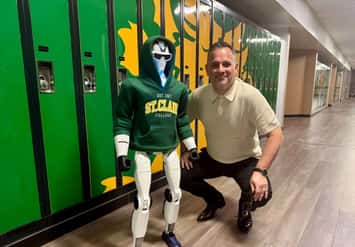
When students return to St. Clair College this fall, they might share the hallways with a new humanoid robot.
The college is the first in North America to receive the newly released Unitree R1 humanoid robot.
"I think we all have come to realize that humanoids are coming. There's no denying that," said John Lopez, a program manager at the college's Research and Innovation Department. "It's trying to get ahead of the curve and to understand what the capabilities are, how the software works, how the hardware works, how to incorporate A.I., and how to incorporate large language models into the humanoid so that we can be more efficient and also help our industry partners."
The robot, which weighs 29 kgs and stands about four feet tall, was purchased from Canadian company InDro Robotics. Funding from the Natural Sciences and Engineering Research Council of Canada helped pay for it.
While the robot can run, walk, even dance, the real potential lies in exploring how advanced robotics, artificial intelligence, and large language models can improve industrial efficiency.
"The potential is kind of unlimited," said head of Research and Development at InDro Robotics, Luke Corbeth. "Humanoids mimic the human form factor, and what makes humanoids so exciting is the world is built for humans, so if you have a robot with that kind of form factor, the infrastructure around it doesn't need to change."
Students and researchers will test the humanoid on practical applications like process monitoring, quality inspection, materials handling, workforce training, and the automation of repetitive or physically demanding tasks.
"I think we have to get involved with this technology as soon as possible," said Nick Dimitrov, an industrial technology advisor with the National Research Council of Canada. "Canada has challenges with productivity. I think these robots will help us bridge that gap."